Et, Voila. Le Texas. C'est la meme.
It's good to be home. This weekend I went with a group of friends to Bastrop State Park, home of the highest concentration of endangered Houston Toads in the world. The Houston Toad, mind you, can only be found in nine counties in Texas, and NOWHERE ELSE IN THE WORLD.
Take that, Paris.
We did the usual things Texans do when they go camping: We ate, drank, biked, hiked, read, napped, and threw stones at a hollowed-out log, trying to outscore one another. I continued my trend of bringing tents from my mother's house which turn out upon inspection to be completely absurd. (The sticky one-man pod beat the eighties dance party tent from last Easter...)
We built what will probably be one of the last fires of the season; summer's familiar sweltering heat isn't far away. Soon I'll wake up in a hot house, already muggy, ready for coffee and a dip in the river.
Ah, the sweet patterns of home. They remind me so much of my life.
So, dear blog followers, you're probably wondering what's coming next. Well, to begin with I'm getting a job and stuff so I can't blog as much...or can I? Isn't useless internetting the very essence of modern employment? I think perhaps so. But what? What shall I blog about? Before it was Paris and now I'm not in Paris so I guess...
...hmmm...
...Texas?
Yes. I shall blog of Texas. Home of the endangered Houston Toad. Home of the hundred degree summers. Home of me.
Stay posted for whether I'm going to create a whole new blog or simply change the title of this one. And if any of you are bloggers out there (or not) and you have suggestions about this matter, please let me know. You can leave your comment in the comments section.
Sunday, April 20, 2008


Saturday, March 29, 2008
Our not-so-faux amis
For our final week in Paris we've been busy seeing friends before we go. Tuesday night was poker night, Wednesday night a concert, Friday night a going away party. Last Sunday we went to the Pop-In for the ol' open mike night, but we got there just after the entire rest of France and decided it was too crowded to stay.
A few of us ended up, therefore, on the patio of an Italian restaurant just down the street. My French friend Marco and I were discussing false cognates (he speaks miraculous English) and I listed my two favorites:
1. Je suis en retard. (I am late.) From looking at it you should be able to see why it is a funny false cognate.
2. En cas d'affluence, ne pas utiliser les strapontins. This is a sign posted on the inside of the metro: It means that if it gets crowded, you can't use the folding seats. But I can't shake the idea that in case you're suddenly affluent, you shouldn't use the seats. I imagine a person riding along on the folding seat, receiving a telephone call (phones work in this metro system), and discovering suddenly that he/she has won the lottery. He/she is elated about this, but has to get up from his/her folding chair. No matter: Now he/she can afford a cab.
Marco asked me again what I called these misleading linguistic relationships, so I repeated: "False cognates."
"Ah," he said. "Do you know what we call them in French?"
"No."
"Faux amis." Which means, literally, "false friends."
We eyed each other suspiciously.
Incidentally, Marco's musical persona is Marco le Recidiviste, which doesn't mean Marco who recedes. It means Marco the Repeat Offender. Just so you know. Also, for the record, he is not at at all a false friend, and neither are any of our others here, though we've known them for a comparatively short time. The traveling friendships one develops with other people who are far from home are fascinating in their quickness, intensity and transience. We are all so eager to replicate that feeling of home - having people who know us, and people whose lives are of interest - and yet, of course, we are nowhere near settled.
Which is one reason I'm so excited to be coming home.
One other friend of sorts that we have to say goodbye to is Paris herself. Over the past nine months I've at times been immune to her charms. I've even spent whole days complaining about the murky weather, which in retrospect I think is still fair. But today, wandering around with Michael on our Last Lazy Saturday in the Marais, I remembered again that Paris is a beautiful and fabulous city. Passing by markets, having noisettes at outdoor cafes, admiring the Place des Voges, and shopping for delicious tea I remembered:
I am going to miss this place.
A few of us ended up, therefore, on the patio of an Italian restaurant just down the street. My French friend Marco and I were discussing false cognates (he speaks miraculous English) and I listed my two favorites:
1. Je suis en retard. (I am late.) From looking at it you should be able to see why it is a funny false cognate.
2. En cas d'affluence, ne pas utiliser les strapontins. This is a sign posted on the inside of the metro: It means that if it gets crowded, you can't use the folding seats. But I can't shake the idea that in case you're suddenly affluent, you shouldn't use the seats. I imagine a person riding along on the folding seat, receiving a telephone call (phones work in this metro system), and discovering suddenly that he/she has won the lottery. He/she is elated about this, but has to get up from his/her folding chair. No matter: Now he/she can afford a cab.
Marco asked me again what I called these misleading linguistic relationships, so I repeated: "False cognates."
"Ah," he said. "Do you know what we call them in French?"
"No."
"Faux amis." Which means, literally, "false friends."
We eyed each other suspiciously.
Incidentally, Marco's musical persona is Marco le Recidiviste, which doesn't mean Marco who recedes. It means Marco the Repeat Offender. Just so you know. Also, for the record, he is not at at all a false friend, and neither are any of our others here, though we've known them for a comparatively short time. The traveling friendships one develops with other people who are far from home are fascinating in their quickness, intensity and transience. We are all so eager to replicate that feeling of home - having people who know us, and people whose lives are of interest - and yet, of course, we are nowhere near settled.
Which is one reason I'm so excited to be coming home.
One other friend of sorts that we have to say goodbye to is Paris herself. Over the past nine months I've at times been immune to her charms. I've even spent whole days complaining about the murky weather, which in retrospect I think is still fair. But today, wandering around with Michael on our Last Lazy Saturday in the Marais, I remembered again that Paris is a beautiful and fabulous city. Passing by markets, having noisettes at outdoor cafes, admiring the Place des Voges, and shopping for delicious tea I remembered:
I am going to miss this place.
Sunday, March 16, 2008
A Nod to My Unpaid Intern
About two years after I graduated from college I secured a spot as an unpaid intern for the Texas Observer in Austin. It's a scrappy little political magazine, quite popular in its way. On my first day, in an attempt to impress the editors, I fell asleep on the couch. This became my routine: Arrive, sleep for 15 minutes, get up, drink coffee, get to work.
My work was proofreading, mostly. And making coffee, sometimes, though I tended to botch that task. I also attended magazine functions, sold subscriptions, folded t-shirts and generally Helped Out. During this time it occurred to me: I need an unpaid intern.
Flash forward three years and here I am, in Paris, with an unpaid intern. His name is Michael Camacho. His other titles include: boyfriend.
His unpaid internship duties mainly pertain to nannying. Michael is, for example, in charge of fighting with Meyer when Meyer is seized with physical ferocity and cannot be placated with anything other than a good old-fashioned throw-down. (Or TV or chocolate but we try to save those for Emergencies.) Michael and Meyer can duke it out in the living room whilst Adam and I sit in the kitchen, calmly drawing, talking about what kinds of dreams we'd had the night before.
As it turns out, though, Michael has proved his usefulness in other ways. He is now also my official unpaid Blog Research Intern, as he has taken it upon himself to read The Mother Tongue; English and How it Got That Way, by Bill Bryson. If it sounds like the perfect book for a linguistics blogger then you're right, it is. But who has time?
So I have allowed my intern to read it for me instead, and he has shared some of the best chunks with me. He has also paraphrased, marked pages, and let me peruse the book EVEN WHILE HE'S READING IT in order to add tidbits of information to this blog entry. Bravo, Intern. Bravo.
I cannot pay you right now but the experience will really bolster your resume.
It deserves note that the word intern is French in origin. It was not used in English until the late 19th century. At the time, it was used solely to denote a medical student, as it was taken from the French interne, meaning, ahem, medical intern.
Of course, the relationship between English and French has long been close; I didn't realize how close until my Intern told me that there was a time when British rulers much preferred French to the harsh babbling language of peasants which would later become the most widely spoken language in the world.
English came together in much the same way that England did, formed in bits after the Romans left and named after the Angles, a Germanic tribe that spoke perhaps the earliest form of English. The French word for English (Anglais) respects these roots as does the French word for England, Angleterre (literally, land of the Angles).
Of course, by the time England came to be, as such, it was inhabited by Saxons as well. Hence, the Anglo-Saxons, who could have no way of knowing, at the time, that they would one day form the middle part of WASP and be featured on countless sitcoms.
There is not much record of the coming together of English or England, for according to Bryson the Anglo-Saxons were, "functionally speaking, illiterate." The first written sentence in English (or the earliest version thereof) was hence found on a coin in a field in Suffolk. It reads: "This she-wolf is a reward to my kinsman." And then, of course, you have a long literary lapse followed by Beowolf whose author had no way of knowing that, one day, Angelina Jolie would play Grendel's hot mom.
Anyway, to keep quickly paraphrasing, the Anglo-Saxons spoke the earliest form of English, which withered a bit on the vine during the Norman invasions and the aristocratic insistence on speaking French. Nevertheless, English is nothing if not persistent. After the English stopped speaking French on account of being mocked by the Parisians for speaking an ugly form of French, the returned to a richer, fuller English. About 85% of the original Old English had been lost by then, but, as Bryson points out:
"4,500 Old English words survived - about 1% of the total words in the Oxford English Dictionary. And yet those surviving words are among the most fundamental words in English: man, wife, child, brother, sister, live, fight, love, drink, sleep, eat, house, and so on."
These are of course all words that do not sound like their French versions. Some of the seemingly less important words, however (including telephone, sim card, rechargeable and charger) DO actually sound a lot like French as I learned yesterday when I translated in the mobile phone store for Michael's mom's friend. I don't want to spend too much time on this, but it was a difficult task indeed: Cell phone plans and operations are difficult enough to understand in English. But no mind.
back to the book: Interesting, non? I will probably have to read this book as soon as I am done reading all the other five million books on my list. Either that or I will have my intern read them for me, and paraphrase. But not now. Right now, he's napping.
My work was proofreading, mostly. And making coffee, sometimes, though I tended to botch that task. I also attended magazine functions, sold subscriptions, folded t-shirts and generally Helped Out. During this time it occurred to me: I need an unpaid intern.
Flash forward three years and here I am, in Paris, with an unpaid intern. His name is Michael Camacho. His other titles include: boyfriend.
His unpaid internship duties mainly pertain to nannying. Michael is, for example, in charge of fighting with Meyer when Meyer is seized with physical ferocity and cannot be placated with anything other than a good old-fashioned throw-down. (Or TV or chocolate but we try to save those for Emergencies.) Michael and Meyer can duke it out in the living room whilst Adam and I sit in the kitchen, calmly drawing, talking about what kinds of dreams we'd had the night before.
As it turns out, though, Michael has proved his usefulness in other ways. He is now also my official unpaid Blog Research Intern, as he has taken it upon himself to read The Mother Tongue; English and How it Got That Way, by Bill Bryson. If it sounds like the perfect book for a linguistics blogger then you're right, it is. But who has time?
So I have allowed my intern to read it for me instead, and he has shared some of the best chunks with me. He has also paraphrased, marked pages, and let me peruse the book EVEN WHILE HE'S READING IT in order to add tidbits of information to this blog entry. Bravo, Intern. Bravo.
I cannot pay you right now but the experience will really bolster your resume.
It deserves note that the word intern is French in origin. It was not used in English until the late 19th century. At the time, it was used solely to denote a medical student, as it was taken from the French interne, meaning, ahem, medical intern.
Of course, the relationship between English and French has long been close; I didn't realize how close until my Intern told me that there was a time when British rulers much preferred French to the harsh babbling language of peasants which would later become the most widely spoken language in the world.
English came together in much the same way that England did, formed in bits after the Romans left and named after the Angles, a Germanic tribe that spoke perhaps the earliest form of English. The French word for English (Anglais) respects these roots as does the French word for England, Angleterre (literally, land of the Angles).
Of course, by the time England came to be, as such, it was inhabited by Saxons as well. Hence, the Anglo-Saxons, who could have no way of knowing, at the time, that they would one day form the middle part of WASP and be featured on countless sitcoms.
There is not much record of the coming together of English or England, for according to Bryson the Anglo-Saxons were, "functionally speaking, illiterate." The first written sentence in English (or the earliest version thereof) was hence found on a coin in a field in Suffolk. It reads: "This she-wolf is a reward to my kinsman." And then, of course, you have a long literary lapse followed by Beowolf whose author had no way of knowing that, one day, Angelina Jolie would play Grendel's hot mom.
Anyway, to keep quickly paraphrasing, the Anglo-Saxons spoke the earliest form of English, which withered a bit on the vine during the Norman invasions and the aristocratic insistence on speaking French. Nevertheless, English is nothing if not persistent. After the English stopped speaking French on account of being mocked by the Parisians for speaking an ugly form of French, the returned to a richer, fuller English. About 85% of the original Old English had been lost by then, but, as Bryson points out:
"4,500 Old English words survived - about 1% of the total words in the Oxford English Dictionary. And yet those surviving words are among the most fundamental words in English: man, wife, child, brother, sister, live, fight, love, drink, sleep, eat, house, and so on."
These are of course all words that do not sound like their French versions. Some of the seemingly less important words, however (including telephone, sim card, rechargeable and charger) DO actually sound a lot like French as I learned yesterday when I translated in the mobile phone store for Michael's mom's friend. I don't want to spend too much time on this, but it was a difficult task indeed: Cell phone plans and operations are difficult enough to understand in English. But no mind.
back to the book: Interesting, non? I will probably have to read this book as soon as I am done reading all the other five million books on my list. Either that or I will have my intern read them for me, and paraphrase. But not now. Right now, he's napping.
Monday, March 3, 2008
A million ways to say Charm
I'm going on a road trip and I'm bringing...
So begins the game "categories." One person lists some things he/she is bringing on the theoretical road trip and others can ask whether that person is bringing certain other things. From yes or no answers the group divines the category of things that the road tripper is taking. We played this game a lot this weekend, as we were, in fact, on a road trip.
Some popular categories included Things that Float in Water, Powerful Homophobes, Places in which the Virgin Mary Appears (tortilla, side of a building, a whole lot of Renaissance art, the Bible). My first attempt at a category went like this:
Me: I'm going on a road trip and I'm bringing chocolate.
Them: Are you bringing alcohol?
Me: Yes.
Them: Is the category things you brought on this road trip?
Me: No. I'm also bringing cigarettes and a baby.
Michael: Things you want that I won't let you have?
Me: I see where you're going with this. And no.
[Pause. Their little brains were working overtime.]
Me: I'm bringing a park. And an alligator.
It was Debs who guessed it, as she guessed many of my categories. Perhaps we think alike. Anyway, probably you - as devoted readers of my blog, who apply its themes to your life every day - guessed it already, too. Did you?
Well the answer is cognates. Words that sound the same in French as they do in English, to be precise.
Another important French/English cognate: Charming. In fact, "charm" is actually from the Old French "charme." Originally the word meant a song or incantation. A spell, basically. And then, during the 16th century, it took on the meaning, "pleasant quality," due either to The Church cracking down on incantations or people's increasing awareness that being put under a spell rocked their socks off.
Anyway, I went on a road trip and I brought Debra, Michael, Amy and Sebastien. My category is People Who are Kick-Ass Company on a road trip. And not only was the company fantastic and the car ride enjoyable, but our drive down from Paris and into the Loire Valley was just about as charming as a charming could be. So charming, in fact, that just now I had to get on the thesaurus to help me out with synonyms for charming. See if you can spot them in this entry.
Our first stop was Orleans, an adorable little town about an hour south of Paris. There, we gawked at the Cathedral Sainte-Croix, which rivals Notre Dame in its Gothic glory. Inside, people were clearly setting up for something special; before we'd been in the town 20 minutes we'd already been offered 2 fliers advertising the upcoming festival for the arrival of the Remains of Ste. Therese at the church that evening. But we declined, for we had distance to travel.
After an adorable little breakfast we drove southwest on the N152, a lovely road which follows the Loire River toward Blois. (Pronounced, more or less: Blwaaaaaa.) It started to dawn on me, during this drive: Paris is to the rest of France what New York City is to the rest of New York. In fact, Paris will probably remind you more of New York City than it will of the rest of rural France. For the rest of France is country.
The Loire River, unlike the Seine, came through the Industrial Revolution relatively unscathed. Farms, rather than factories and overpopulation, line its banks, which are miraculously still composed largely of land. Irrigation from the river and plenty of rainfall made the fields around us richly green, even in late winter.
After a half hour or so, we arrived in the adorable town of Amboise, home to our first Chateau, the Chateau d'Amboise. This Chateau was more fortress than architectural eloquence, but it was, of course, still beautiful. The most precious part were the terraces, from which you could see the adorable town of Amboise spread out before you. You can also see the Chateau's cathedral, where Leonardo da Vinci is [sort of] interned. Here it is:
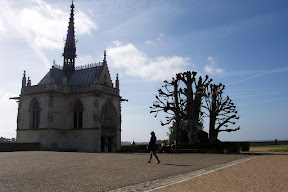
Back during the start of the Religious Wars in France, a bunch of Protestants were slaughtered in retribution for an assassination attempt on a Catholic prince at Amboise. Their bodies were hung quaintly from the ramparts of the castle. The smell was so adorable that the court had to temporarily move away.
We passed the night in Tours, but first we stopped at a vineyard to taste some white wine. In my awkward but improving French I explained to the proprietor the story of Goldilocks and the Three Bears and the practice of using owls on organic vineyards to dive-bomb gophers. Given my lack of vocabulary (note, owl = hibou) I was forced to use a lot of body language. The man, although taken aback at first, was eventually, I think, charmed.
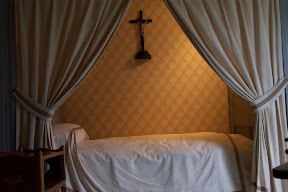
After a night's stay at the lovely Hotel Colbert and a charmingly overpriced breakfast in the morning, we made our way back north, taking an eastern detour. First we visited the Chateau Sache, which is more of a large estate than a true Chateau. This is where Balzac came from Tours in the summers to read and write in peace, thus provoking the following question: Which one of you is going to put me up in your castle so I can write books? I don't need a moat or anything fancy. Just a private Cathedral and some space for the horses to graze. And a bed like this:
From Sache we went north to the Chateau Chenonceau. It's a stunning feat of engineering, built across the River Cher. Like so:
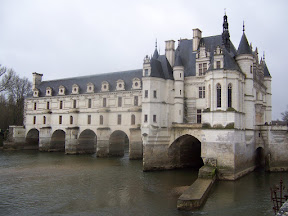
The King, Henry III, made a gift of the Chateau to his mistress, Diane de Poiters, as thanks for "services rendered the crown." Services, indeed.
When the King died, his wife, Catherine de Medici, demanded that the Chateau be returned to her. But she offered Diane another Chateau in exchange, so don't go thinking it's all unfair or anything.
In the First World War the gallery became a hospital, and in the Second World War, it turned out that the North entrance to the castle was in the German occupied zone, and the south (across the river, through the main gallery) was in the Free Zone. People would literally make their escape through this hall:
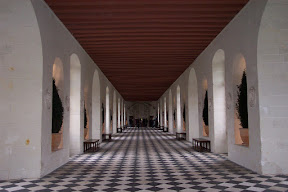
What's funny is that now the south door is equipped with an emergency exit sign. In case of war.
After a charming lunch in Montrichard, we headed north again to the Chateau Chambord. Leonardo da Vinci is credited with some of its stunning design, but I didn't get to learn much more because the castle closes charmingly early in the winter. We did manage to get some pretty nice pictures of the outside. See?
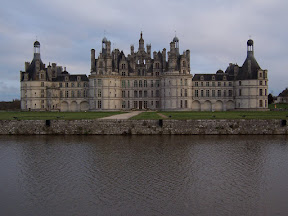
And there's a chance we might come back down this way again. Depends on timing and money, but Kristin and Mike are our next visitors so we'll see if we can swing it again. I want to go check out the Chambord and I want to see Chateau Cheverny, as well.
I also want to play Charades with more viticulturists who don't know what Charades is, or that they're playing Charades. So, perhaps...I'm going on another road trip and this time I'm bringing Kristin and Mike? We'll see.
Anyhow, I know this entry was a long one. But I just can't say enough good things about the trip: Excellent company, excellent scenery, excellent food, etc. France outside Paris is something else entirely, and I feel a little ridiculous for having just now discovered it. Last night, as I drifted off, images of castles and winding staircases and clear rivers and ramparts and cathedrals drifted before my closed eyes and I fell asleep feeling like royalty.
So I'm going on a road trip and I'm bringing Crime & Punishment, being stuck in traffic, and this blog. Make your own guess.
So begins the game "categories." One person lists some things he/she is bringing on the theoretical road trip and others can ask whether that person is bringing certain other things. From yes or no answers the group divines the category of things that the road tripper is taking. We played this game a lot this weekend, as we were, in fact, on a road trip.
Some popular categories included Things that Float in Water, Powerful Homophobes, Places in which the Virgin Mary Appears (tortilla, side of a building, a whole lot of Renaissance art, the Bible). My first attempt at a category went like this:
Me: I'm going on a road trip and I'm bringing chocolate.
Them: Are you bringing alcohol?
Me: Yes.
Them: Is the category things you brought on this road trip?
Me: No. I'm also bringing cigarettes and a baby.
Michael: Things you want that I won't let you have?
Me: I see where you're going with this. And no.
[Pause. Their little brains were working overtime.]
Me: I'm bringing a park. And an alligator.
It was Debs who guessed it, as she guessed many of my categories. Perhaps we think alike. Anyway, probably you - as devoted readers of my blog, who apply its themes to your life every day - guessed it already, too. Did you?
Well the answer is cognates. Words that sound the same in French as they do in English, to be precise.
Another important French/English cognate: Charming. In fact, "charm" is actually from the Old French "charme." Originally the word meant a song or incantation. A spell, basically. And then, during the 16th century, it took on the meaning, "pleasant quality," due either to The Church cracking down on incantations or people's increasing awareness that being put under a spell rocked their socks off.
Anyway, I went on a road trip and I brought Debra, Michael, Amy and Sebastien. My category is People Who are Kick-Ass Company on a road trip. And not only was the company fantastic and the car ride enjoyable, but our drive down from Paris and into the Loire Valley was just about as charming as a charming could be. So charming, in fact, that just now I had to get on the thesaurus to help me out with synonyms for charming. See if you can spot them in this entry.
Our first stop was Orleans, an adorable little town about an hour south of Paris. There, we gawked at the Cathedral Sainte-Croix, which rivals Notre Dame in its Gothic glory. Inside, people were clearly setting up for something special; before we'd been in the town 20 minutes we'd already been offered 2 fliers advertising the upcoming festival for the arrival of the Remains of Ste. Therese at the church that evening. But we declined, for we had distance to travel.
After an adorable little breakfast we drove southwest on the N152, a lovely road which follows the Loire River toward Blois. (Pronounced, more or less: Blwaaaaaa.) It started to dawn on me, during this drive: Paris is to the rest of France what New York City is to the rest of New York. In fact, Paris will probably remind you more of New York City than it will of the rest of rural France. For the rest of France is country.
The Loire River, unlike the Seine, came through the Industrial Revolution relatively unscathed. Farms, rather than factories and overpopulation, line its banks, which are miraculously still composed largely of land. Irrigation from the river and plenty of rainfall made the fields around us richly green, even in late winter.
After a half hour or so, we arrived in the adorable town of Amboise, home to our first Chateau, the Chateau d'Amboise. This Chateau was more fortress than architectural eloquence, but it was, of course, still beautiful. The most precious part were the terraces, from which you could see the adorable town of Amboise spread out before you. You can also see the Chateau's cathedral, where Leonardo da Vinci is [sort of] interned. Here it is:
Back during the start of the Religious Wars in France, a bunch of Protestants were slaughtered in retribution for an assassination attempt on a Catholic prince at Amboise. Their bodies were hung quaintly from the ramparts of the castle. The smell was so adorable that the court had to temporarily move away.
We passed the night in Tours, but first we stopped at a vineyard to taste some white wine. In my awkward but improving French I explained to the proprietor the story of Goldilocks and the Three Bears and the practice of using owls on organic vineyards to dive-bomb gophers. Given my lack of vocabulary (note, owl = hibou) I was forced to use a lot of body language. The man, although taken aback at first, was eventually, I think, charmed.
After a night's stay at the lovely Hotel Colbert and a charmingly overpriced breakfast in the morning, we made our way back north, taking an eastern detour. First we visited the Chateau Sache, which is more of a large estate than a true Chateau. This is where Balzac came from Tours in the summers to read and write in peace, thus provoking the following question: Which one of you is going to put me up in your castle so I can write books? I don't need a moat or anything fancy. Just a private Cathedral and some space for the horses to graze. And a bed like this:
From Sache we went north to the Chateau Chenonceau. It's a stunning feat of engineering, built across the River Cher. Like so:
The King, Henry III, made a gift of the Chateau to his mistress, Diane de Poiters, as thanks for "services rendered the crown." Services, indeed.
When the King died, his wife, Catherine de Medici, demanded that the Chateau be returned to her. But she offered Diane another Chateau in exchange, so don't go thinking it's all unfair or anything.
In the First World War the gallery became a hospital, and in the Second World War, it turned out that the North entrance to the castle was in the German occupied zone, and the south (across the river, through the main gallery) was in the Free Zone. People would literally make their escape through this hall:
What's funny is that now the south door is equipped with an emergency exit sign. In case of war.
After a charming lunch in Montrichard, we headed north again to the Chateau Chambord. Leonardo da Vinci is credited with some of its stunning design, but I didn't get to learn much more because the castle closes charmingly early in the winter. We did manage to get some pretty nice pictures of the outside. See?
And there's a chance we might come back down this way again. Depends on timing and money, but Kristin and Mike are our next visitors so we'll see if we can swing it again. I want to go check out the Chambord and I want to see Chateau Cheverny, as well.
I also want to play Charades with more viticulturists who don't know what Charades is, or that they're playing Charades. So, perhaps...I'm going on another road trip and this time I'm bringing Kristin and Mike? We'll see.
Anyhow, I know this entry was a long one. But I just can't say enough good things about the trip: Excellent company, excellent scenery, excellent food, etc. France outside Paris is something else entirely, and I feel a little ridiculous for having just now discovered it. Last night, as I drifted off, images of castles and winding staircases and clear rivers and ramparts and cathedrals drifted before my closed eyes and I fell asleep feeling like royalty.
So I'm going on a road trip and I'm bringing Crime & Punishment, being stuck in traffic, and this blog. Make your own guess.
Thursday, February 28, 2008
Just Walk Across the Bridge and You're There
Everytime I hear German or Dutch spoken (which so far has been when I was in Germany and Holland, respectively) I remember that English is derived from these languages. If I listen from far enough away, the words blur together and sound almost like somebody speaking English with a really heavy accent I can't quite pinpoint.
It's interesting; English shares so many derivatives with French and Spanish that seeing those languages written tends to trick one into thinking they're closer than they are. But hearing them is something else entirely. It took me four months of hearing French every day to realize when one word was starting and another was ending, and it was more from trial and error than actual aural acumen.
Not so with Dutch, which is one of the many things I noticed over last weekend, when I went to Amsterdam with Michael and Debs. Hearing Dutch I think: Wow, it's like Holland was a colonial power in the 17th century and they spread their linguistic seeds everywhere, including our very own New World. But reading English written by Dutch can be confusing. For example, if the directions to your cabin say "Just walk across the bridge and you're there" you might think it was going to be a simple jaunt, instead of a twenty minute hike under a suspension bridge near an industrial canal. You would also then wonder about the phrase: "Surrounded by nature."
In fact, my very first impressions of Amsterdam were wary at best. Until about 1:30 am on the first night I had basically boiled the city down to a post-apocolyptic Vegas. When we first emerged from the Centraal Station, we were met with clouds in the sky and construction on the ground. Then came our introduction to our Post-Apocolyptic Hut (as we lovingly named it after we realized that in the summer it must bustle but for now it just creaked, eerily) and I was about to throw in the towel on the city. No wonder they've legalized drugs, I thought.
But then at night the lights from the lamps reflected in the water. The air was fresh off the sea; it tasted amazing. In the morning, the sun came out. Somewhere along the Stigel canal, which winds its way along with all its cousins and brothers through a picturesque Old World City, I realized: Wait, this place is amazing.
It appears I've been chronically underestimating the Dutch my whole life. Mainly by forgetting about them. For example, I was surprised to remember the whole Golden Age (when Holland was the richest nation in the world), the Dutch East India Company, and Rembrandt. Oh, and Van Gogh and Anne Frank, both of whom have wonderful museums dedicated to them in this winding city full of tall, good-looking people who are really, really good at riding on the backs of bikes whilst others pedal forward.
I'm including a link to some pictures I took: http://picasaweb.google.com/kellyokelly/Amsterdamnit
But I warn you, they're disappointing. It's not that I didn't try. It's just that the dimensions there are impossible to capture on film. The depth and stillness that the water adds to the city, which rises straight up from the canals in rows of narrow buildings, is difficult to capture on anything but a panoramic, three-dimensional camera. It's really extraordinarily pretty in a very unique way, and I'm not just saying that because I spent a lot of time in coffeeshops, indulging my weakness for Dutch...er...coffee.
That's another English word the Dutch use that, written, is confusing. Coffeeshop. We see that and we think: Maybe if the proprietor had had his coffee he wouldn't have missed the punctuation in the sign. But then we realize, oh, duh. In Amsterdam "Coffeeshop" means something like, I don't know, "Civil Liberties." Roughly translated. So we had ourselves a grand old time and I realized, once and for all, that when it comes to vices real coffee is just about as good as they come.
So that's about it. We got back on Monday night and I've been working during the day, entertaining company by night. (Here, in another interesting linguistic twist, "entertaining" means delegating my nanny duties to friends and guests.) On Saturday morning we're taking a weekend road trip to the Loire Valley to see chateaux and drink wine.
According to the website we "just drive down the A10 a little ways" and we're there. Which is a claim we will have to wait to judge for now.
It's interesting; English shares so many derivatives with French and Spanish that seeing those languages written tends to trick one into thinking they're closer than they are. But hearing them is something else entirely. It took me four months of hearing French every day to realize when one word was starting and another was ending, and it was more from trial and error than actual aural acumen.
Not so with Dutch, which is one of the many things I noticed over last weekend, when I went to Amsterdam with Michael and Debs. Hearing Dutch I think: Wow, it's like Holland was a colonial power in the 17th century and they spread their linguistic seeds everywhere, including our very own New World. But reading English written by Dutch can be confusing. For example, if the directions to your cabin say "Just walk across the bridge and you're there" you might think it was going to be a simple jaunt, instead of a twenty minute hike under a suspension bridge near an industrial canal. You would also then wonder about the phrase: "Surrounded by nature."
In fact, my very first impressions of Amsterdam were wary at best. Until about 1:30 am on the first night I had basically boiled the city down to a post-apocolyptic Vegas. When we first emerged from the Centraal Station, we were met with clouds in the sky and construction on the ground. Then came our introduction to our Post-Apocolyptic Hut (as we lovingly named it after we realized that in the summer it must bustle but for now it just creaked, eerily) and I was about to throw in the towel on the city. No wonder they've legalized drugs, I thought.
But then at night the lights from the lamps reflected in the water. The air was fresh off the sea; it tasted amazing. In the morning, the sun came out. Somewhere along the Stigel canal, which winds its way along with all its cousins and brothers through a picturesque Old World City, I realized: Wait, this place is amazing.
It appears I've been chronically underestimating the Dutch my whole life. Mainly by forgetting about them. For example, I was surprised to remember the whole Golden Age (when Holland was the richest nation in the world), the Dutch East India Company, and Rembrandt. Oh, and Van Gogh and Anne Frank, both of whom have wonderful museums dedicated to them in this winding city full of tall, good-looking people who are really, really good at riding on the backs of bikes whilst others pedal forward.
I'm including a link to some pictures I took: http://picasaweb.google.com/kellyokelly/Amsterdamnit
But I warn you, they're disappointing. It's not that I didn't try. It's just that the dimensions there are impossible to capture on film. The depth and stillness that the water adds to the city, which rises straight up from the canals in rows of narrow buildings, is difficult to capture on anything but a panoramic, three-dimensional camera. It's really extraordinarily pretty in a very unique way, and I'm not just saying that because I spent a lot of time in coffeeshops, indulging my weakness for Dutch...er...coffee.
That's another English word the Dutch use that, written, is confusing. Coffeeshop. We see that and we think: Maybe if the proprietor had had his coffee he wouldn't have missed the punctuation in the sign. But then we realize, oh, duh. In Amsterdam "Coffeeshop" means something like, I don't know, "Civil Liberties." Roughly translated. So we had ourselves a grand old time and I realized, once and for all, that when it comes to vices real coffee is just about as good as they come.
So that's about it. We got back on Monday night and I've been working during the day, entertaining company by night. (Here, in another interesting linguistic twist, "entertaining" means delegating my nanny duties to friends and guests.) On Saturday morning we're taking a weekend road trip to the Loire Valley to see chateaux and drink wine.
According to the website we "just drive down the A10 a little ways" and we're there. Which is a claim we will have to wait to judge for now.
Saturday, February 9, 2008
Blog au Crudite
Here's an interesting cognate: cru is the French word for raw. Thus, for example, you can get a poulet au crudites sandwich, which means you're getting chicken (not raw) with crudites (raw vegetables). At my new-favorite Marais restaurant Le Petit Marche, where we ate with John Nation and Catherine Cunningham during their wonderful stay here last week, you can get a thon a cru (raw tuna) or you can verbally wrestle with the waiter in awkward French until he finally sends his English-speaking coworker to tell you that lotte is a monkfish and yes, it's cooked, and yes, you can have it for dinner.
Just recently, my sister sent an update email from her Harlem apartment. For those of you who don't know or aren't my sister, she is doing Teach for American in the Bronx. It is apparently an experience which is alternately inspirational and harrowing. She points out in her email, as I often did in my emails when I worked at the Hippie School, that children's emotions can best be defined as raw.
Which got me thinking about the French cognate, and how we refer to a person who speaks too much and without thinking: crude. Trust me, I know all about these people. They're everywhere. Even sometimes in this apartment. Typing at this computer.
With children it seems our job, as the adults who care for them, is too teach them to take their raw emotions (frustration, fear, sadness) and help them put them in perspective, or at least help them, say, not throw yogurt all over the floor in a fit of fury when it turns out they wanted to stir it themselves. Random example. This will be a helpful skill later in restaurants when they're on dates.
So what we're doing is taking a raw emotion and adding bits of socially acceptable seasoning, mulling it over until it softens a bit, perhaps roasting it on a spit so it gets evenly cooked and presenting it to the world in a digestible fashion.
Please note we're cooking the childrens' emotions and not the children themselves. Lisa and Ben sometimes read this blog so as their children's nanny, I want to be very clear on that point.
For the most part, I think teaching children to cook their emotions just a little bit is a crucial tool. If only because a moment's pause or perspective can help show you that everything, actually, is okay. You're still going to get a turn. There's plenty of food. The ladybug didn't actually eat you. (Ladybugs don't eat raw children, see...)
But I also think adults would be well-served, sometimes, by revisiting raw emotions. We tend to maybe over-cook things. Until they're burned. Like, for example, this metaphor.
Anyway, I feel pretty lucky to work with kids, if only because it's fun to sometimes react to things like a kid. For example, I'm looking forward to our trip to Amsterdam with a child's excitement. Debs is going to be up from Austin and the three of us found cheap train tickets to the city, where we will visit the Van Gogh Museum, ride bikes, enjoy the canals, and see what else there is to do. Nothing comes to mind. Suggestions welcome.
I'm pretty excited about all our visitors: Kristin and Mike, Debs, Michael's mom, maybe Mary. The list goes on. We've had such a good time with our visitors so far (Bob, John, Catherine, Ally) that I can't wait to welcome more into our humble little apartment, which everyone reacts to with a grown-up, processed, slightly cooked version of their original sentiment (Egad! Where will I sleep!) by saying things like: "It's so...cute!"
Just recently, my sister sent an update email from her Harlem apartment. For those of you who don't know or aren't my sister, she is doing Teach for American in the Bronx. It is apparently an experience which is alternately inspirational and harrowing. She points out in her email, as I often did in my emails when I worked at the Hippie School, that children's emotions can best be defined as raw.
Which got me thinking about the French cognate, and how we refer to a person who speaks too much and without thinking: crude. Trust me, I know all about these people. They're everywhere. Even sometimes in this apartment. Typing at this computer.
With children it seems our job, as the adults who care for them, is too teach them to take their raw emotions (frustration, fear, sadness) and help them put them in perspective, or at least help them, say, not throw yogurt all over the floor in a fit of fury when it turns out they wanted to stir it themselves. Random example. This will be a helpful skill later in restaurants when they're on dates.
So what we're doing is taking a raw emotion and adding bits of socially acceptable seasoning, mulling it over until it softens a bit, perhaps roasting it on a spit so it gets evenly cooked and presenting it to the world in a digestible fashion.
Please note we're cooking the childrens' emotions and not the children themselves. Lisa and Ben sometimes read this blog so as their children's nanny, I want to be very clear on that point.
For the most part, I think teaching children to cook their emotions just a little bit is a crucial tool. If only because a moment's pause or perspective can help show you that everything, actually, is okay. You're still going to get a turn. There's plenty of food. The ladybug didn't actually eat you. (Ladybugs don't eat raw children, see...)
But I also think adults would be well-served, sometimes, by revisiting raw emotions. We tend to maybe over-cook things. Until they're burned. Like, for example, this metaphor.
Anyway, I feel pretty lucky to work with kids, if only because it's fun to sometimes react to things like a kid. For example, I'm looking forward to our trip to Amsterdam with a child's excitement. Debs is going to be up from Austin and the three of us found cheap train tickets to the city, where we will visit the Van Gogh Museum, ride bikes, enjoy the canals, and see what else there is to do. Nothing comes to mind. Suggestions welcome.
I'm pretty excited about all our visitors: Kristin and Mike, Debs, Michael's mom, maybe Mary. The list goes on. We've had such a good time with our visitors so far (Bob, John, Catherine, Ally) that I can't wait to welcome more into our humble little apartment, which everyone reacts to with a grown-up, processed, slightly cooked version of their original sentiment (Egad! Where will I sleep!) by saying things like: "It's so...cute!"
Tuesday, January 29, 2008
Nuts!
This is a blog mostly about English. Specifically, it is about the word: Nuts.
The word "nut" was first used to denote a hard seed. It shares its origin with the pre-Germanic "knu-" as in, later, nucleus. But that was just the beginning of its long and varied journey through the English language.
Here, I'll just give you what online etymology says about it:
Nuts: "crazy," 1846, from earlier be nutts upon "be very fond of" (1785), which is possibly from nuts (n., pl.) "any source of pleasure" (1617), from nut (q.v.).
Sense influenced probably by metaphoric application of nut to "head" (1846, e.g. to be off one's nut "be insane," 1860). Nut "crazy person, crank" is attested from 1903, (British form nutter first attested 1958).
Connection with the slang "testicle" sense has tended to nudge it toward taboo. "On the N.B.C. network, it is forbidden to call any character a nut; you have to call him a screwball." ["New Yorker," Dec. 23, 1950] "Please eliminate the expression 'nuts to you' from Egbert's speech." [Request from the Hays Office regarding the script of "The Bank Dick," 1940] This desire for avoidance accounts for the euphemism nerts (c.1925). Nutty "crazy" is first attested 1898.
Isn't that a lot of information?
And can we pause for a moment and wonder just how much money goes into telling people in this country that they can't say "nut" on N.B.C? By the way, in Europe, where there's no FCC, the commercials are a lot funnier.
But anyway, the best part about the myriad uses of nuts is the opportunity for unwitting puns from small children. For example, Meyer and Adam (who are both nuts, by the way) have been really into collecting nuts in the park. And then we have the following conversation:
Meyer: "Kelly, I'm about to go play a game. So I need you to keep my nuts safe."
Kelly: "Meyer, why don't you put your nuts somewhere safe yourself?"
Meyer: "I don't know where a safe place to put my nuts is."
Kelly: "What about your room?"
Meyer: (thinking about it) "Well, will you put them there?"
Kelly: "Meyer, nobody can take care of your nuts except for you."
Adam (running in): "Kelly, do you want to play with my nuts while I go to the bathroom?"
Kelly: "What? No. No thank you."
I know it's juvenile but it's funny every time. Lately I've been reminding Adam and Meyer, frequently, that they're nuts. Meyer has cleared up some of the mystery surrounding his own nuttiness. For example on the way home today, when Meyer was running in concentric circles, shouting rhyming nonsense at the birds and giggling maniacally...
Kelly: "Wow! The cold is making you nuts!"
Meyer: (yelling into the sky): "It's not the cold! I was just born funny!"
Adam: (matter-of-factly) "For me it's the cold."
But besides Adam and Meyer, things are going well. We eat well. We sleep well, and late. I've been submitting some stories, so we'll see how that goes. On Saturday our friends Jessica & Liam cooked us a Turkish meal spiced with things they picked up from their holiday trip to Istanbul. It was delicious.
I was happy to learn that Turkish Delight is, in fact, real. It isn't something the White Witch made up to lure Edmund away from Aslan. Now that I've had it, I have to say I don't blame the kid. Not that we were ever highly convinced of my allegience to Good anyway. It depends on what Good can do for me.
And that's about it for now, really. It's a lovely life, but its largely home-based. Lots of writing and sleeping. We sleep. And then, when we're done sleeping, eating and writing, it's usually time to go see Adam and Meyer. And play with their nuts.
The word "nut" was first used to denote a hard seed. It shares its origin with the pre-Germanic "knu-" as in, later, nucleus. But that was just the beginning of its long and varied journey through the English language.
Here, I'll just give you what online etymology says about it:
Nuts: "crazy," 1846, from earlier be nutts upon "be very fond of" (1785), which is possibly from nuts (n., pl.) "any source of pleasure" (1617), from nut (q.v.).
Sense influenced probably by metaphoric application of nut to "head" (1846, e.g. to be off one's nut "be insane," 1860). Nut "crazy person, crank" is attested from 1903, (British form nutter first attested 1958).
Connection with the slang "testicle" sense has tended to nudge it toward taboo. "On the N.B.C. network, it is forbidden to call any character a nut; you have to call him a screwball." ["New Yorker," Dec. 23, 1950] "Please eliminate the expression 'nuts to you' from Egbert's speech." [Request from the Hays Office regarding the script of "The Bank Dick," 1940] This desire for avoidance accounts for the euphemism nerts (c.1925). Nutty "crazy" is first attested 1898.
Isn't that a lot of information?
And can we pause for a moment and wonder just how much money goes into telling people in this country that they can't say "nut" on N.B.C? By the way, in Europe, where there's no FCC, the commercials are a lot funnier.
But anyway, the best part about the myriad uses of nuts is the opportunity for unwitting puns from small children. For example, Meyer and Adam (who are both nuts, by the way) have been really into collecting nuts in the park. And then we have the following conversation:
Meyer: "Kelly, I'm about to go play a game. So I need you to keep my nuts safe."
Kelly: "Meyer, why don't you put your nuts somewhere safe yourself?"
Meyer: "I don't know where a safe place to put my nuts is."
Kelly: "What about your room?"
Meyer: (thinking about it) "Well, will you put them there?"
Kelly: "Meyer, nobody can take care of your nuts except for you."
Adam (running in): "Kelly, do you want to play with my nuts while I go to the bathroom?"
Kelly: "What? No. No thank you."
I know it's juvenile but it's funny every time. Lately I've been reminding Adam and Meyer, frequently, that they're nuts. Meyer has cleared up some of the mystery surrounding his own nuttiness. For example on the way home today, when Meyer was running in concentric circles, shouting rhyming nonsense at the birds and giggling maniacally...
Kelly: "Wow! The cold is making you nuts!"
Meyer: (yelling into the sky): "It's not the cold! I was just born funny!"
Adam: (matter-of-factly) "For me it's the cold."
But besides Adam and Meyer, things are going well. We eat well. We sleep well, and late. I've been submitting some stories, so we'll see how that goes. On Saturday our friends Jessica & Liam cooked us a Turkish meal spiced with things they picked up from their holiday trip to Istanbul. It was delicious.
I was happy to learn that Turkish Delight is, in fact, real. It isn't something the White Witch made up to lure Edmund away from Aslan. Now that I've had it, I have to say I don't blame the kid. Not that we were ever highly convinced of my allegience to Good anyway. It depends on what Good can do for me.
And that's about it for now, really. It's a lovely life, but its largely home-based. Lots of writing and sleeping. We sleep. And then, when we're done sleeping, eating and writing, it's usually time to go see Adam and Meyer. And play with their nuts.
Sunday, January 13, 2008
Bienvenue!
Everyone should know how to say "Welcome!" in lots of languages. Right? In French, we say "Bienvenue!" And everyone should know Thank You (Merci) and Please (Sil vous plait) and You're Welcome (de rien). So that at least we can be polite.
Except, if you're French-Canadian, these basics can be confusing. In French, as in Spanish, the precise translation of "you're welcome" (as in, the response to Thank You) is actually "it's nothing." De Rien means, literally, "of nothing."
But in Canada, where the French is mixed with the English from next-door, someone will say "Merci" and be met with "Bienvenue." Because the Frenglish mixes "you're welcome" with its literal translation, which is "bienvenue." Which is funny.
It's also why Canada is in desperate need of native French to come and translate (dub) their American TV shows. So that there remains some semblance of proper French, as if any language is a static or proper thing. But its also why Isabelle Neyret moved from Paris to Montreal to dub shows such as Smallville. And when she left, she left an apartment and a studio in the 19th. Where we now stay. So you see, its all related.
Anyway, the point of all that is that I'm back in Paris. Michael is with me. I'm recovering from jet-lag, which is to say, in the past month, I've been from Paris to Texas. Texas to Hawaii. Hawaii to Texas. Texas to New York. New York to Paris. My internal clock has sputtered, bleeped, and imploded. I don't know when to sleep, when to shit, when to be hungry. But life will settle out - for the next two months, at least.
To be brief, Hawaii is as beautiful as they say. We stayed on Kauai (pronouced: kwai), the Garden Isle, home to a mountainous coast and the wettest spot on Earth. It rained, sporadically, for twenty minutes at a time about ten times a day. But the payoff? Lusciousness. Waterfalls. Surf.
What is deceptive about Hawaii is its distance from the mainland. On maps, we see it in its little box right next to California. But it is not, as the ten hour plane ride assured us, right next to California. Not in the slightest. It is, in fact, in the middle of the Pacific Ocean. Which I guess explains why we acquired the place; not, in fact, purely as a vacation spot for deserving Americans. But rather, as a strategic naval base. And also a delightful vacation spot.
Delightful, indeed. We surfed. We did a helicopter tour. We rafted around the island. We ziplined over valleys and swam in the ocean. We layed around the condo and read books and watched TV. My dad got hitched. I kauai'd. It was lovely.
Texas was just an acrobatic attempt to see all my friends, and to catch up with them on their lives, which apparently went on in full force in my absence. Shocking, I know, but true. Babies were conceived, babies were born. Weddings were planned, break-ups were orchestrated. Hairs were cut. Beards were grown and shaved. Jobs were quit and houses were bought. Law school semesters were completed. All in all, it was a whirlwind and a half just to keep track of the crazies.
New York was lovely, too. Caitlin lives in a beautiful Harlem brownstone, near 145th, right around the corner from the Tenenbaum house, in fact. Her roommates are great. We went to the Whitney, ate dinner with my cousin Tim, and went to my favorite village restaurant, the Grey Dog. Other than that, we mostly slept in and watched Curb your Enthusiasm on DVD.
But it was wonderful, and I spent the whole time glad to be coming back to Texas - in the end - and glad to be headed off for Paris Round 2, as well. I feel entirely welcome in both spots. This time around, we'll hopefully welcome quite a few visitors: Bob arrives in a couple of days, and Kristin & Mike will be here for their spring break. Lots of others have mentioned coming, but my new policy is to not believe it until I'm sent a flight itinerary.
So if you've always wanted to come to Paris - or, hell, Texas, for that matter - you're welcome, to be sure, with open arms. Bienvenue!
Except, if you're French-Canadian, these basics can be confusing. In French, as in Spanish, the precise translation of "you're welcome" (as in, the response to Thank You) is actually "it's nothing." De Rien means, literally, "of nothing."
But in Canada, where the French is mixed with the English from next-door, someone will say "Merci" and be met with "Bienvenue." Because the Frenglish mixes "you're welcome" with its literal translation, which is "bienvenue." Which is funny.
It's also why Canada is in desperate need of native French to come and translate (dub) their American TV shows. So that there remains some semblance of proper French, as if any language is a static or proper thing. But its also why Isabelle Neyret moved from Paris to Montreal to dub shows such as Smallville. And when she left, she left an apartment and a studio in the 19th. Where we now stay. So you see, its all related.
Anyway, the point of all that is that I'm back in Paris. Michael is with me. I'm recovering from jet-lag, which is to say, in the past month, I've been from Paris to Texas. Texas to Hawaii. Hawaii to Texas. Texas to New York. New York to Paris. My internal clock has sputtered, bleeped, and imploded. I don't know when to sleep, when to shit, when to be hungry. But life will settle out - for the next two months, at least.
To be brief, Hawaii is as beautiful as they say. We stayed on Kauai (pronouced: kwai), the Garden Isle, home to a mountainous coast and the wettest spot on Earth. It rained, sporadically, for twenty minutes at a time about ten times a day. But the payoff? Lusciousness. Waterfalls. Surf.
What is deceptive about Hawaii is its distance from the mainland. On maps, we see it in its little box right next to California. But it is not, as the ten hour plane ride assured us, right next to California. Not in the slightest. It is, in fact, in the middle of the Pacific Ocean. Which I guess explains why we acquired the place; not, in fact, purely as a vacation spot for deserving Americans. But rather, as a strategic naval base. And also a delightful vacation spot.
Delightful, indeed. We surfed. We did a helicopter tour. We rafted around the island. We ziplined over valleys and swam in the ocean. We layed around the condo and read books and watched TV. My dad got hitched. I kauai'd. It was lovely.
Texas was just an acrobatic attempt to see all my friends, and to catch up with them on their lives, which apparently went on in full force in my absence. Shocking, I know, but true. Babies were conceived, babies were born. Weddings were planned, break-ups were orchestrated. Hairs were cut. Beards were grown and shaved. Jobs were quit and houses were bought. Law school semesters were completed. All in all, it was a whirlwind and a half just to keep track of the crazies.
New York was lovely, too. Caitlin lives in a beautiful Harlem brownstone, near 145th, right around the corner from the Tenenbaum house, in fact. Her roommates are great. We went to the Whitney, ate dinner with my cousin Tim, and went to my favorite village restaurant, the Grey Dog. Other than that, we mostly slept in and watched Curb your Enthusiasm on DVD.
But it was wonderful, and I spent the whole time glad to be coming back to Texas - in the end - and glad to be headed off for Paris Round 2, as well. I feel entirely welcome in both spots. This time around, we'll hopefully welcome quite a few visitors: Bob arrives in a couple of days, and Kristin & Mike will be here for their spring break. Lots of others have mentioned coming, but my new policy is to not believe it until I'm sent a flight itinerary.
So if you've always wanted to come to Paris - or, hell, Texas, for that matter - you're welcome, to be sure, with open arms. Bienvenue!
Subscribe to:
Posts (Atom)


