For our final week in Paris we've been busy seeing friends before we go. Tuesday night was poker night, Wednesday night a concert, Friday night a going away party. Last Sunday we went to the Pop-In for the ol' open mike night, but we got there just after the entire rest of France and decided it was too crowded to stay.
A few of us ended up, therefore, on the patio of an Italian restaurant just down the street. My French friend Marco and I were discussing false cognates (he speaks miraculous English) and I listed my two favorites:
1. Je suis en retard. (I am late.) From looking at it you should be able to see why it is a funny false cognate.
2. En cas d'affluence, ne pas utiliser les strapontins. This is a sign posted on the inside of the metro: It means that if it gets crowded, you can't use the folding seats. But I can't shake the idea that in case you're suddenly affluent, you shouldn't use the seats. I imagine a person riding along on the folding seat, receiving a telephone call (phones work in this metro system), and discovering suddenly that he/she has won the lottery. He/she is elated about this, but has to get up from his/her folding chair. No matter: Now he/she can afford a cab.
Marco asked me again what I called these misleading linguistic relationships, so I repeated: "False cognates."
"Ah," he said. "Do you know what we call them in French?"
"No."
"Faux amis." Which means, literally, "false friends."
We eyed each other suspiciously.
Incidentally, Marco's musical persona is Marco le Recidiviste, which doesn't mean Marco who recedes. It means Marco the Repeat Offender. Just so you know. Also, for the record, he is not at at all a false friend, and neither are any of our others here, though we've known them for a comparatively short time. The traveling friendships one develops with other people who are far from home are fascinating in their quickness, intensity and transience. We are all so eager to replicate that feeling of home - having people who know us, and people whose lives are of interest - and yet, of course, we are nowhere near settled.
Which is one reason I'm so excited to be coming home.
One other friend of sorts that we have to say goodbye to is Paris herself. Over the past nine months I've at times been immune to her charms. I've even spent whole days complaining about the murky weather, which in retrospect I think is still fair. But today, wandering around with Michael on our Last Lazy Saturday in the Marais, I remembered again that Paris is a beautiful and fabulous city. Passing by markets, having noisettes at outdoor cafes, admiring the Place des Voges, and shopping for delicious tea I remembered:
I am going to miss this place.
Saturday, March 29, 2008


Sunday, March 16, 2008
A Nod to My Unpaid Intern
About two years after I graduated from college I secured a spot as an unpaid intern for the Texas Observer in Austin. It's a scrappy little political magazine, quite popular in its way. On my first day, in an attempt to impress the editors, I fell asleep on the couch. This became my routine: Arrive, sleep for 15 minutes, get up, drink coffee, get to work.
My work was proofreading, mostly. And making coffee, sometimes, though I tended to botch that task. I also attended magazine functions, sold subscriptions, folded t-shirts and generally Helped Out. During this time it occurred to me: I need an unpaid intern.
Flash forward three years and here I am, in Paris, with an unpaid intern. His name is Michael Camacho. His other titles include: boyfriend.
His unpaid internship duties mainly pertain to nannying. Michael is, for example, in charge of fighting with Meyer when Meyer is seized with physical ferocity and cannot be placated with anything other than a good old-fashioned throw-down. (Or TV or chocolate but we try to save those for Emergencies.) Michael and Meyer can duke it out in the living room whilst Adam and I sit in the kitchen, calmly drawing, talking about what kinds of dreams we'd had the night before.
As it turns out, though, Michael has proved his usefulness in other ways. He is now also my official unpaid Blog Research Intern, as he has taken it upon himself to read The Mother Tongue; English and How it Got That Way, by Bill Bryson. If it sounds like the perfect book for a linguistics blogger then you're right, it is. But who has time?
So I have allowed my intern to read it for me instead, and he has shared some of the best chunks with me. He has also paraphrased, marked pages, and let me peruse the book EVEN WHILE HE'S READING IT in order to add tidbits of information to this blog entry. Bravo, Intern. Bravo.
I cannot pay you right now but the experience will really bolster your resume.
It deserves note that the word intern is French in origin. It was not used in English until the late 19th century. At the time, it was used solely to denote a medical student, as it was taken from the French interne, meaning, ahem, medical intern.
Of course, the relationship between English and French has long been close; I didn't realize how close until my Intern told me that there was a time when British rulers much preferred French to the harsh babbling language of peasants which would later become the most widely spoken language in the world.
English came together in much the same way that England did, formed in bits after the Romans left and named after the Angles, a Germanic tribe that spoke perhaps the earliest form of English. The French word for English (Anglais) respects these roots as does the French word for England, Angleterre (literally, land of the Angles).
Of course, by the time England came to be, as such, it was inhabited by Saxons as well. Hence, the Anglo-Saxons, who could have no way of knowing, at the time, that they would one day form the middle part of WASP and be featured on countless sitcoms.
There is not much record of the coming together of English or England, for according to Bryson the Anglo-Saxons were, "functionally speaking, illiterate." The first written sentence in English (or the earliest version thereof) was hence found on a coin in a field in Suffolk. It reads: "This she-wolf is a reward to my kinsman." And then, of course, you have a long literary lapse followed by Beowolf whose author had no way of knowing that, one day, Angelina Jolie would play Grendel's hot mom.
Anyway, to keep quickly paraphrasing, the Anglo-Saxons spoke the earliest form of English, which withered a bit on the vine during the Norman invasions and the aristocratic insistence on speaking French. Nevertheless, English is nothing if not persistent. After the English stopped speaking French on account of being mocked by the Parisians for speaking an ugly form of French, the returned to a richer, fuller English. About 85% of the original Old English had been lost by then, but, as Bryson points out:
"4,500 Old English words survived - about 1% of the total words in the Oxford English Dictionary. And yet those surviving words are among the most fundamental words in English: man, wife, child, brother, sister, live, fight, love, drink, sleep, eat, house, and so on."
These are of course all words that do not sound like their French versions. Some of the seemingly less important words, however (including telephone, sim card, rechargeable and charger) DO actually sound a lot like French as I learned yesterday when I translated in the mobile phone store for Michael's mom's friend. I don't want to spend too much time on this, but it was a difficult task indeed: Cell phone plans and operations are difficult enough to understand in English. But no mind.
back to the book: Interesting, non? I will probably have to read this book as soon as I am done reading all the other five million books on my list. Either that or I will have my intern read them for me, and paraphrase. But not now. Right now, he's napping.
My work was proofreading, mostly. And making coffee, sometimes, though I tended to botch that task. I also attended magazine functions, sold subscriptions, folded t-shirts and generally Helped Out. During this time it occurred to me: I need an unpaid intern.
Flash forward three years and here I am, in Paris, with an unpaid intern. His name is Michael Camacho. His other titles include: boyfriend.
His unpaid internship duties mainly pertain to nannying. Michael is, for example, in charge of fighting with Meyer when Meyer is seized with physical ferocity and cannot be placated with anything other than a good old-fashioned throw-down. (Or TV or chocolate but we try to save those for Emergencies.) Michael and Meyer can duke it out in the living room whilst Adam and I sit in the kitchen, calmly drawing, talking about what kinds of dreams we'd had the night before.
As it turns out, though, Michael has proved his usefulness in other ways. He is now also my official unpaid Blog Research Intern, as he has taken it upon himself to read The Mother Tongue; English and How it Got That Way, by Bill Bryson. If it sounds like the perfect book for a linguistics blogger then you're right, it is. But who has time?
So I have allowed my intern to read it for me instead, and he has shared some of the best chunks with me. He has also paraphrased, marked pages, and let me peruse the book EVEN WHILE HE'S READING IT in order to add tidbits of information to this blog entry. Bravo, Intern. Bravo.
I cannot pay you right now but the experience will really bolster your resume.
It deserves note that the word intern is French in origin. It was not used in English until the late 19th century. At the time, it was used solely to denote a medical student, as it was taken from the French interne, meaning, ahem, medical intern.
Of course, the relationship between English and French has long been close; I didn't realize how close until my Intern told me that there was a time when British rulers much preferred French to the harsh babbling language of peasants which would later become the most widely spoken language in the world.
English came together in much the same way that England did, formed in bits after the Romans left and named after the Angles, a Germanic tribe that spoke perhaps the earliest form of English. The French word for English (Anglais) respects these roots as does the French word for England, Angleterre (literally, land of the Angles).
Of course, by the time England came to be, as such, it was inhabited by Saxons as well. Hence, the Anglo-Saxons, who could have no way of knowing, at the time, that they would one day form the middle part of WASP and be featured on countless sitcoms.
There is not much record of the coming together of English or England, for according to Bryson the Anglo-Saxons were, "functionally speaking, illiterate." The first written sentence in English (or the earliest version thereof) was hence found on a coin in a field in Suffolk. It reads: "This she-wolf is a reward to my kinsman." And then, of course, you have a long literary lapse followed by Beowolf whose author had no way of knowing that, one day, Angelina Jolie would play Grendel's hot mom.
Anyway, to keep quickly paraphrasing, the Anglo-Saxons spoke the earliest form of English, which withered a bit on the vine during the Norman invasions and the aristocratic insistence on speaking French. Nevertheless, English is nothing if not persistent. After the English stopped speaking French on account of being mocked by the Parisians for speaking an ugly form of French, the returned to a richer, fuller English. About 85% of the original Old English had been lost by then, but, as Bryson points out:
"4,500 Old English words survived - about 1% of the total words in the Oxford English Dictionary. And yet those surviving words are among the most fundamental words in English: man, wife, child, brother, sister, live, fight, love, drink, sleep, eat, house, and so on."
These are of course all words that do not sound like their French versions. Some of the seemingly less important words, however (including telephone, sim card, rechargeable and charger) DO actually sound a lot like French as I learned yesterday when I translated in the mobile phone store for Michael's mom's friend. I don't want to spend too much time on this, but it was a difficult task indeed: Cell phone plans and operations are difficult enough to understand in English. But no mind.
back to the book: Interesting, non? I will probably have to read this book as soon as I am done reading all the other five million books on my list. Either that or I will have my intern read them for me, and paraphrase. But not now. Right now, he's napping.
Monday, March 3, 2008
A million ways to say Charm
I'm going on a road trip and I'm bringing...
So begins the game "categories." One person lists some things he/she is bringing on the theoretical road trip and others can ask whether that person is bringing certain other things. From yes or no answers the group divines the category of things that the road tripper is taking. We played this game a lot this weekend, as we were, in fact, on a road trip.
Some popular categories included Things that Float in Water, Powerful Homophobes, Places in which the Virgin Mary Appears (tortilla, side of a building, a whole lot of Renaissance art, the Bible). My first attempt at a category went like this:
Me: I'm going on a road trip and I'm bringing chocolate.
Them: Are you bringing alcohol?
Me: Yes.
Them: Is the category things you brought on this road trip?
Me: No. I'm also bringing cigarettes and a baby.
Michael: Things you want that I won't let you have?
Me: I see where you're going with this. And no.
[Pause. Their little brains were working overtime.]
Me: I'm bringing a park. And an alligator.
It was Debs who guessed it, as she guessed many of my categories. Perhaps we think alike. Anyway, probably you - as devoted readers of my blog, who apply its themes to your life every day - guessed it already, too. Did you?
Well the answer is cognates. Words that sound the same in French as they do in English, to be precise.
Another important French/English cognate: Charming. In fact, "charm" is actually from the Old French "charme." Originally the word meant a song or incantation. A spell, basically. And then, during the 16th century, it took on the meaning, "pleasant quality," due either to The Church cracking down on incantations or people's increasing awareness that being put under a spell rocked their socks off.
Anyway, I went on a road trip and I brought Debra, Michael, Amy and Sebastien. My category is People Who are Kick-Ass Company on a road trip. And not only was the company fantastic and the car ride enjoyable, but our drive down from Paris and into the Loire Valley was just about as charming as a charming could be. So charming, in fact, that just now I had to get on the thesaurus to help me out with synonyms for charming. See if you can spot them in this entry.
Our first stop was Orleans, an adorable little town about an hour south of Paris. There, we gawked at the Cathedral Sainte-Croix, which rivals Notre Dame in its Gothic glory. Inside, people were clearly setting up for something special; before we'd been in the town 20 minutes we'd already been offered 2 fliers advertising the upcoming festival for the arrival of the Remains of Ste. Therese at the church that evening. But we declined, for we had distance to travel.
After an adorable little breakfast we drove southwest on the N152, a lovely road which follows the Loire River toward Blois. (Pronounced, more or less: Blwaaaaaa.) It started to dawn on me, during this drive: Paris is to the rest of France what New York City is to the rest of New York. In fact, Paris will probably remind you more of New York City than it will of the rest of rural France. For the rest of France is country.
The Loire River, unlike the Seine, came through the Industrial Revolution relatively unscathed. Farms, rather than factories and overpopulation, line its banks, which are miraculously still composed largely of land. Irrigation from the river and plenty of rainfall made the fields around us richly green, even in late winter.
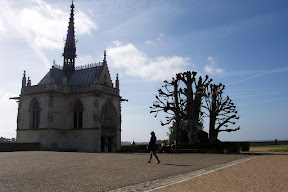
After a half hour or so, we arrived in the adorable town of Amboise, home to our first Chateau, the Chateau d'Amboise. This Chateau was more fortress than architectural eloquence, but it was, of course, still beautiful. The most precious part were the terraces, from which you could see the adorable town of Amboise spread out before you. You can also see the Chateau's cathedral, where Leonardo da Vinci is [sort of] interned. Here it is:
Back during the start of the Religious Wars in France, a bunch of Protestants were slaughtered in retribution for an assassination attempt on a Catholic prince at Amboise. Their bodies were hung quaintly from the ramparts of the castle. The smell was so adorable that the court had to temporarily move away.
We passed the night in Tours, but first we stopped at a vineyard to taste some white wine. In my awkward but improving French I explained to the proprietor the story of Goldilocks and the Three Bears and the practice of using owls on organic vineyards to dive-bomb gophers. Given my lack of vocabulary (note, owl = hibou) I was forced to use a lot of body language. The man, although taken aback at first, was eventually, I think, charmed.
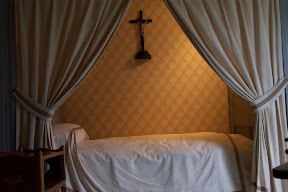
After a night's stay at the lovely Hotel Colbert and a charmingly overpriced breakfast in the morning, we made our way back north, taking an eastern detour. First we visited the Chateau Sache, which is more of a large estate than a true Chateau. This is where Balzac came from Tours in the summers to read and write in peace, thus provoking the following question: Which one of you is going to put me up in your castle so I can write books? I don't need a moat or anything fancy. Just a private Cathedral and some space for the horses to graze. And a bed like this:
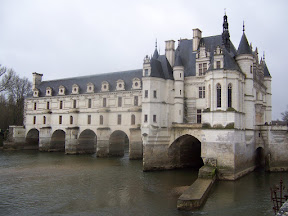
From Sache we went north to the Chateau Chenonceau. It's a stunning feat of engineering, built across the River Cher. Like so:
The King, Henry III, made a gift of the Chateau to his mistress, Diane de Poiters, as thanks for "services rendered the crown." Services, indeed.
When the King died, his wife, Catherine de Medici, demanded that the Chateau be returned to her. But she offered Diane another Chateau in exchange, so don't go thinking it's all unfair or anything.
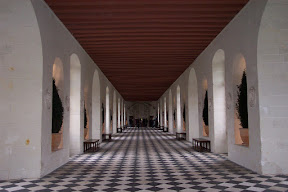
In the First World War the gallery became a hospital, and in the Second World War, it turned out that the North entrance to the castle was in the German occupied zone, and the south (across the river, through the main gallery) was in the Free Zone. People would literally make their escape through this hall:
What's funny is that now the south door is equipped with an emergency exit sign. In case of war.
After a charming lunch in Montrichard, we headed north again to the Chateau Chambord. Leonardo da Vinci is credited with some of its stunning design, but I didn't get to learn much more because the castle closes charmingly early in the winter. We did manage to get some pretty nice pictures of the outside. See?
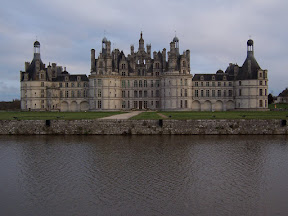
And there's a chance we might come back down this way again. Depends on timing and money, but Kristin and Mike are our next visitors so we'll see if we can swing it again. I want to go check out the Chambord and I want to see Chateau Cheverny, as well.
I also want to play Charades with more viticulturists who don't know what Charades is, or that they're playing Charades. So, perhaps...I'm going on another road trip and this time I'm bringing Kristin and Mike? We'll see.
Anyhow, I know this entry was a long one. But I just can't say enough good things about the trip: Excellent company, excellent scenery, excellent food, etc. France outside Paris is something else entirely, and I feel a little ridiculous for having just now discovered it. Last night, as I drifted off, images of castles and winding staircases and clear rivers and ramparts and cathedrals drifted before my closed eyes and I fell asleep feeling like royalty.
So I'm going on a road trip and I'm bringing Crime & Punishment, being stuck in traffic, and this blog. Make your own guess.
So begins the game "categories." One person lists some things he/she is bringing on the theoretical road trip and others can ask whether that person is bringing certain other things. From yes or no answers the group divines the category of things that the road tripper is taking. We played this game a lot this weekend, as we were, in fact, on a road trip.
Some popular categories included Things that Float in Water, Powerful Homophobes, Places in which the Virgin Mary Appears (tortilla, side of a building, a whole lot of Renaissance art, the Bible). My first attempt at a category went like this:
Me: I'm going on a road trip and I'm bringing chocolate.
Them: Are you bringing alcohol?
Me: Yes.
Them: Is the category things you brought on this road trip?
Me: No. I'm also bringing cigarettes and a baby.
Michael: Things you want that I won't let you have?
Me: I see where you're going with this. And no.
[Pause. Their little brains were working overtime.]
Me: I'm bringing a park. And an alligator.
It was Debs who guessed it, as she guessed many of my categories. Perhaps we think alike. Anyway, probably you - as devoted readers of my blog, who apply its themes to your life every day - guessed it already, too. Did you?
Well the answer is cognates. Words that sound the same in French as they do in English, to be precise.
Another important French/English cognate: Charming. In fact, "charm" is actually from the Old French "charme." Originally the word meant a song or incantation. A spell, basically. And then, during the 16th century, it took on the meaning, "pleasant quality," due either to The Church cracking down on incantations or people's increasing awareness that being put under a spell rocked their socks off.
Anyway, I went on a road trip and I brought Debra, Michael, Amy and Sebastien. My category is People Who are Kick-Ass Company on a road trip. And not only was the company fantastic and the car ride enjoyable, but our drive down from Paris and into the Loire Valley was just about as charming as a charming could be. So charming, in fact, that just now I had to get on the thesaurus to help me out with synonyms for charming. See if you can spot them in this entry.
Our first stop was Orleans, an adorable little town about an hour south of Paris. There, we gawked at the Cathedral Sainte-Croix, which rivals Notre Dame in its Gothic glory. Inside, people were clearly setting up for something special; before we'd been in the town 20 minutes we'd already been offered 2 fliers advertising the upcoming festival for the arrival of the Remains of Ste. Therese at the church that evening. But we declined, for we had distance to travel.
After an adorable little breakfast we drove southwest on the N152, a lovely road which follows the Loire River toward Blois. (Pronounced, more or less: Blwaaaaaa.) It started to dawn on me, during this drive: Paris is to the rest of France what New York City is to the rest of New York. In fact, Paris will probably remind you more of New York City than it will of the rest of rural France. For the rest of France is country.
The Loire River, unlike the Seine, came through the Industrial Revolution relatively unscathed. Farms, rather than factories and overpopulation, line its banks, which are miraculously still composed largely of land. Irrigation from the river and plenty of rainfall made the fields around us richly green, even in late winter.
After a half hour or so, we arrived in the adorable town of Amboise, home to our first Chateau, the Chateau d'Amboise. This Chateau was more fortress than architectural eloquence, but it was, of course, still beautiful. The most precious part were the terraces, from which you could see the adorable town of Amboise spread out before you. You can also see the Chateau's cathedral, where Leonardo da Vinci is [sort of] interned. Here it is:
Back during the start of the Religious Wars in France, a bunch of Protestants were slaughtered in retribution for an assassination attempt on a Catholic prince at Amboise. Their bodies were hung quaintly from the ramparts of the castle. The smell was so adorable that the court had to temporarily move away.
We passed the night in Tours, but first we stopped at a vineyard to taste some white wine. In my awkward but improving French I explained to the proprietor the story of Goldilocks and the Three Bears and the practice of using owls on organic vineyards to dive-bomb gophers. Given my lack of vocabulary (note, owl = hibou) I was forced to use a lot of body language. The man, although taken aback at first, was eventually, I think, charmed.
After a night's stay at the lovely Hotel Colbert and a charmingly overpriced breakfast in the morning, we made our way back north, taking an eastern detour. First we visited the Chateau Sache, which is more of a large estate than a true Chateau. This is where Balzac came from Tours in the summers to read and write in peace, thus provoking the following question: Which one of you is going to put me up in your castle so I can write books? I don't need a moat or anything fancy. Just a private Cathedral and some space for the horses to graze. And a bed like this:
From Sache we went north to the Chateau Chenonceau. It's a stunning feat of engineering, built across the River Cher. Like so:
The King, Henry III, made a gift of the Chateau to his mistress, Diane de Poiters, as thanks for "services rendered the crown." Services, indeed.
When the King died, his wife, Catherine de Medici, demanded that the Chateau be returned to her. But she offered Diane another Chateau in exchange, so don't go thinking it's all unfair or anything.
In the First World War the gallery became a hospital, and in the Second World War, it turned out that the North entrance to the castle was in the German occupied zone, and the south (across the river, through the main gallery) was in the Free Zone. People would literally make their escape through this hall:
What's funny is that now the south door is equipped with an emergency exit sign. In case of war.
After a charming lunch in Montrichard, we headed north again to the Chateau Chambord. Leonardo da Vinci is credited with some of its stunning design, but I didn't get to learn much more because the castle closes charmingly early in the winter. We did manage to get some pretty nice pictures of the outside. See?
And there's a chance we might come back down this way again. Depends on timing and money, but Kristin and Mike are our next visitors so we'll see if we can swing it again. I want to go check out the Chambord and I want to see Chateau Cheverny, as well.
I also want to play Charades with more viticulturists who don't know what Charades is, or that they're playing Charades. So, perhaps...I'm going on another road trip and this time I'm bringing Kristin and Mike? We'll see.
Anyhow, I know this entry was a long one. But I just can't say enough good things about the trip: Excellent company, excellent scenery, excellent food, etc. France outside Paris is something else entirely, and I feel a little ridiculous for having just now discovered it. Last night, as I drifted off, images of castles and winding staircases and clear rivers and ramparts and cathedrals drifted before my closed eyes and I fell asleep feeling like royalty.
So I'm going on a road trip and I'm bringing Crime & Punishment, being stuck in traffic, and this blog. Make your own guess.
Subscribe to:
Posts (Atom)


